How to create Flash USDT using ChainIDE and MetaMask
· based on the channel Rca FastPrint
Flash USDT is an innovative method to create a USDT-like ERC20 token using smart contract development tools such as ChainIDE and wallet interfaces like MetaMask. This process involves coding, deploying, and interacting with smart contracts on the Ethereum blockchain, enabling users to simulate or test token functionalities in a controlled environment.
Understanding Flash USDT and Its Concept
Flash USDT refers to a token that mimics the functionality of Tether (USDT) but is created through custom smart contracts deployed on Ethereum or compatible blockchains. Unlike official USDT tokens issued by Tether, Flash USDT tokens are typically used for educational, development, or testing purposes, often involving the ERC20 token standard.
Key characteristics of Flash USDT include:
- It follows the ERC20 token structure, ensuring compatibility with Ethereum wallets and decentralized applications.
- It is created using smart contracts that define token supply, transfers, and other standard functionalities.
- It is not backed by real assets and should not be confused with legitimate USDT tokens.
Setting Up ChainIDE for Flash USDT Development
ChainIDE (https://chainide.com/) is a cloud-based integrated development environment optimized for blockchain development. It allows developers to write, compile, and deploy smart contracts directly from the browser without local setup.
Steps to set up ChainIDE for Flash USDT:
- Register or log in to ChainIDE to access the development workspace.
- Create a new Solidity project and add the ERC20 token contract code tailored for Flash USDT.
- Use the provided ChainIDE script for Flash USDT creation, which can be found at https://sites.google.com/view/defiflashusdt.
- Compile the smart contract to check for syntax errors and compatibility.
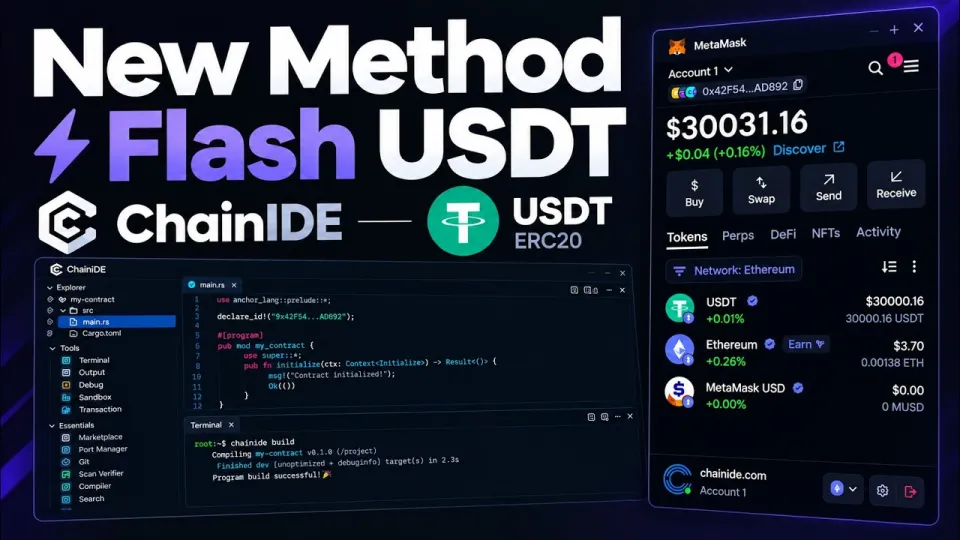
Video: Flash USDT | Found a NEW Method on ChainIDE
Flash USDT Token Structure and ERC20 Standard
The ERC20 standard defines the interface and functionalities for tokens on Ethereum. The Flash USDT contract typically includes:
- totalSupply: Defines the total amount of tokens minted.
- balanceOf: Allows querying token balances for each address.
- transfer and transferFrom: Functions to move tokens between addresses.
- approve and allowance: Manage token spending permissions.
Creating Flash USDT involves customizing these functions to simulate a USDT token, usually with fixed supply and transfer mechanisms.
Connecting MetaMask to Interact with Flash USDT
MetaMask is a popular Ethereum wallet that facilitates interaction with decentralized applications and smart contracts.
To connect MetaMask for Flash USDT:
- Install MetaMask browser extension or mobile app.
- Configure MetaMask to use the Ethereum network or test networks like Ropsten or Goerli.
- Import or create a wallet to manage your tokens.
- In ChainIDE, deploy the Flash USDT contract and record the contract address.
- Use MetaMask to add the new token by inputting the contract address.
- Interact with the token through MetaMask’s interface or via decentralized applications.
Smart Contract Deployment and Testing Workflow
Deploying Flash USDT involves several critical steps:
- Writing the Solidity contract code according to ERC20 standards.
- Compiling and testing the contract in ChainIDE’s environment.
- Deploying the contract to the Ethereum mainnet or testnet.
- Verifying the deployed contract’s source code for transparency.
- Testing token transfers and functions to ensure proper behavior.
It’s important to conduct testing on testnets to avoid loss of real funds.
Common Mistakes and Precautions When Creating Flash USDT
Creating and interacting with Flash USDT contracts requires caution. Common pitfalls include:
- Sending real funds to unverified or unknown contracts.
- Failing to verify contract source code and address.
- Confusing Flash USDT tokens with official USDT tokens on exchanges.
- Misconfiguring MetaMask network settings, leading to transaction failures.
Always review contract code independently and avoid signing transactions without full understanding.
Useful Links
- ChainIDE official site for development and deployment: https://chainide.com/
- Flash USDT creation script and guide: https://sites.google.com/view/defiflashusdt
Итог
Creating Flash USDT tokens is an educational and development-focused process that leverages ChainIDE and MetaMask to build and test ERC20 tokens resembling USDT. This method offers valuable insights into smart contract workflows and decentralized token creation without involving real asset backing. The Rca FastPrint channel provides a detailed walkthrough that helps users understand the setup, deployment, and interaction stages. For anyone interested in blockchain development or DeFi experiments, exploring Flash USDT with ChainIDE is a practical starting point. Remember to use official resources like ChainIDE (https://chainide.com/) for safe and efficient development.
Key takeaways
- Flash USDT is an ERC20 token created via smart contracts on Ethereum.
- ChainIDE is an online development environment used to write and deploy smart contracts.
- MetaMask connects wallets to Ethereum network for contract interaction.
- Flash USDT creation involves coding, testing, and deploying ERC20 tokens.
- Verifying contract details and avoiding real funds on unknown contracts is crucial.
Source: Flash USDT | Found a NEW Method on ChainIDE · Markdown version
Questions & answers
What exactly is Flash USDT?
Flash USDT is a custom ERC20 token that mimics the USDT stablecoin's functions but is created through smart contracts for educational or testing purposes. It is not an official or real USDT token backed by Tether.
How does ChainIDE help in creating Flash USDT?
ChainIDE is an online integrated development environment that enables writing, compiling, and deploying smart contracts like Flash USDT directly from the browser, simplifying the token creation process.
Can I use Flash USDT for real transactions?
No, Flash USDT tokens are intended for development, testing, and educational use only. They do not represent real assets and should not be used for real-world transactions or investments.
Why should I be careful when interacting with Flash USDT contracts?
Interacting with unverified smart contracts can lead to security risks and potential loss of funds. It is essential to verify contract addresses, source code, and network details before signing any transactions with MetaMask or other wallets.